UX Writing That Turns Browsers into Buyers

A website is a room people enter with one hand full of distractions and one hand empty, hoping to be helped. UX writing is the quiet person in that room who points to the right shelf, tucks a friendly note into the package, and hands the visitor a small, believable promise.
It does not perform miracles; it clears the path, and it respects the fact that most humans are tired, hungry, scrolling, and suspicious of anything that smells like a hard sell. Good UX writing begins with listening more than speaking.
It notices the tiny hesitations in a form, the way a label can feel like an obstacle, the way a confident button can feel like a handshake. It trades clever lines for clear directions, and it trades obscure terms for the kind of speech someone trusts at midnight when they are deciding whether to click buy.
1) How Psychology Shapes Every Click
How users move through a website is rarely random; it is guided by subtle psychological cues embedded in every word. Cognitive load, the mental effort required to process information, can drastically affect a page, and even a small barrier in understanding can lead to abandoned carts or skipped sign-ups.
Fear of missing out, urgency, and the clarity of instructions play equally powerful roles, nudging visitors toward action without them realizing it. Bayshore Communications approaches UX writing with this behavioral insight at the core, blending psychology and design to produce copy that feels intuitive, reassuring, and persuasive.
According to the invespcro, microcopy optimized for clarity and context can lift conversion rates by up to 15%, proving that thoughtful words influence engagement and noticeable business outcomes.
2) Tiny Tweaks That Spark Major Conversions

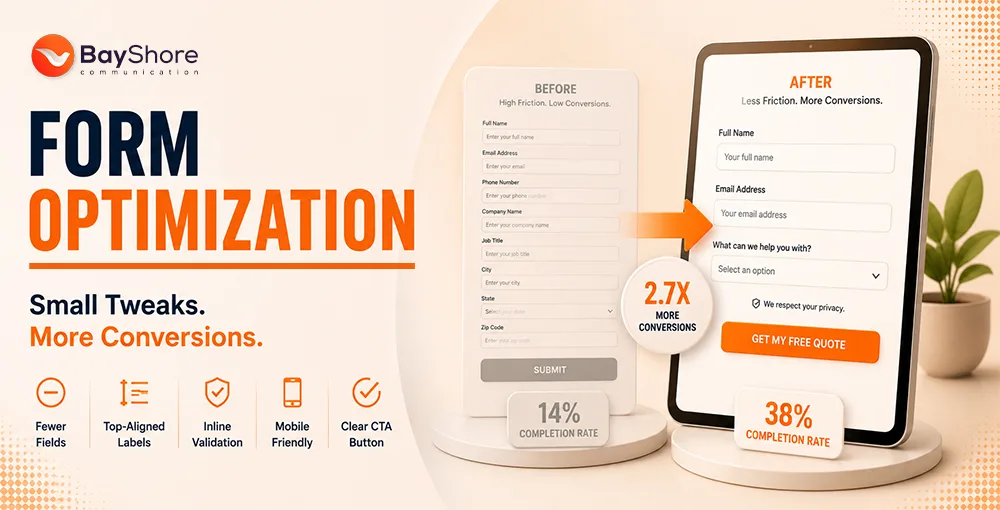
Small adjustments in UX writing can lead to significant increases in conversions, yet many brands overlook these opportunities. For instance, changing a call to action from “Submit” to “Get My Free Guide” can make the action feel more valuable. It is encouraging visitors to engage without requiring a complete redesign.
Adding clear, helpful hints that guide users step by step can reduce frustration and confusion. While empathetic error messages keep users on track and maintain trust and understanding of consumer behavior.
Bayshore Communications is partnered with clients like Apex Advisor, Digital Xperience Group, Hess Spinal and Medical Centers, and many more clients, implementing a single strategic tweak in onboarding copy that increased sign-ups by a higher percentage than before. It shows how minor changes can produce major results.
HubSpot does emphasize the importance of conversion rate optimization (CRO) and highlights that even small changes, such as rewriting headlines or simplifying forms, can lead to significant improvements in conversion rates
We always pay attention to the smallest details in copy; brands can create a smoother, more persuasive user experience that drives higher engagement and conversions.
3) Finding the Right Voice for Every Brand
When it comes to UX writing, tone is the subtle force that guides user perception, builds trust, and influences behavior. A mismatch between a brand's voice and its audience's expectations can create friction, erode confidence, and ultimately drive users away.
Forbes emphasizes that aligning content with a brand's identity is fundamental. However, utilizing content to voice a brand's personality is what allows them to connect meaningfully with their audience.
Bayshore Communications understands that defining and implementing a consistent voice is crucial for resonating with target audiences. Their process involves:
Conversational vs. Formal Tone Decisions: Determining the appropriate level of formality based on the context and audience to ensure relatability without compromising professionalism.
Empathy and Reassurance in Messaging: Crafting messages that acknowledge user concerns and provide clear, supportive guidance to enhance user experience.
Aligning Copy with Brand Identity Across Touchpoints: Ensuring consistency in voice across all user interactions to reinforce brand identity and build trust.
4) Turning Words into Measurable Wins

In UX writing, words are subtle levers that guide behavior. A simple change in phrasing, placement, or tone can nudge a hesitant visitor into action. While bold visuals draw attention, thoughtfully crafted microcopy often drives the actual conversions, turning curiosity into measurable results.
Bayshore Communications combines creativity with analytics to make these words work harder. They use data to understand how users respond, then apply that insight to optimize microcopy for maximum impact. Here’s how:
A/B Testing: This involves presenting two versions of the same page to different users and tracking which one performs better. For example, testing a button that says “Sign Up” versus “Claim Your Free Trial” can reveal which phrasing motivates more clicks.
Heatmaps: Heatmaps visually show where users click, hover, or scroll. Bayshore might find that users consistently ignore a CTA at the bottom of a page, prompting a reposition or rewrite to increase visibility.
Conversion Tracking: This measures how many users complete desired actions, such as signing up for a newsletter or finishing a purchase. Bayshore can determine which wording changes are most effective by tracking click-through rates, form completions, and bounce rates.
These methods are not guesswork. According to the World Bank, effective digital communication strategies that incorporate testing and optimization can improve user engagement and conversion rates significantly. For instance, a simple rewording of a checkout button or form instruction can increase conversions by up to 20 percent, showing that tiny words can create huge wins.
With Bayshore’s approach, every line of copy is treated as an opportunity to improve performance, making words a measurable, profitable asset rather than just filler on a page.
5) Building a Culture Where Every Word Matters
UX writing is a practice that grows alongside your users and your business goals. Language shapes every moment someone spends with your brand, so overlooking it lets great design underperform and costs both trust and conversions. Treat words as part of the product, because tiny phrases often decide whether a browser becomes a buyer. Bayshore Communications treats copy as a living element of the product experience, continuously refining and optimizing to ensure every word earns its place.
Central to this approach is collaboration. Designers, writers, and strategists work together to craft messages that feel natural, intuitive, and persuasive. Bayshore’s teams align creative insight with user data, making sure that microcopy doesn’t just look good—it performs. This culture of precision ensures that the brand voice remains consistent, relatable, and conversion-driven across every touchpoint.
The long-term benefits of this approach are tangible: higher user trust, stronger engagement, increased retention, and measurable business growth. Bayshore supports this culture through structured practices:
Regular Copy Audits: Reviewing existing content to identify friction points, outdated messaging, or missed opportunities for clarity.
Iterative Testing and Feedback Loops: Continuously testing small changes in microcopy, collecting results, and refining language based on performance insights.
Knowledge Sharing and Internal UX Writing Guidelines: Establishing clear documentation and best practices to ensure all teams maintain a consistent, effective brand voice.
When an organization implements these practices into the workflow, Bayshore Communications ensures that every word contributes to a smooth, persuasive user experience, turning small language choices into measurable business wins.
6) The Power of Words Done Right

Sometimes a single word does the heavy lifting. It can close the gap between doubt and decision, tame a tiny fear, or turn a casual glance into a long-term habit. UX writing is quiet work, but its effects fan out across metrics, trust, and how a brand feels in someone’s pocket.
We compose for behavior. We combine behavioral insight, storytelling craft, and hard data so each line earns its place on the page. That means headlines that grab attention without shouting, form copy that reduces friction, and microcopy that answers the questions people do not always ask out loud.
We write to persuade with respect. Our words guide clicks, lower resistance, and build confidence, because persuasion without integrity is just noise. The brands that last are the ones whose words are precise, generous, and unpretentious.
If you want language that moves people and improves outcomes, we turn your copy into a tool, not a billboard. Send us a note, and let’s make one sentence do the work of a campaign.