Marketing Attribution | Florida Growth Analytics
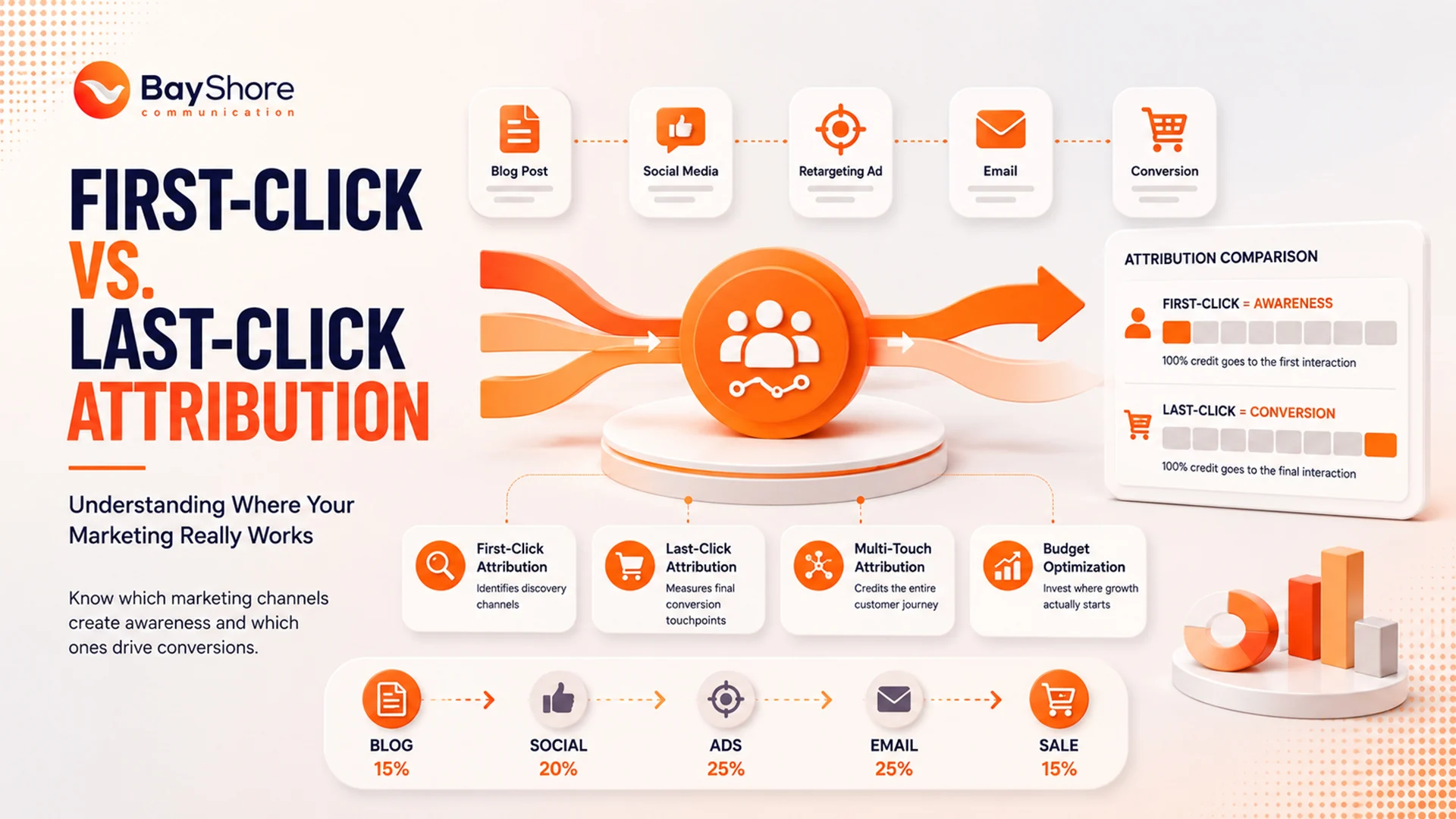
First-click attribution marks the first touchpoint a customer interacts with. Last-click credits the final one before conversion. Neither tells the full story by itself. Smart Florida businesses track both to understand what drives awareness and what closes the deal.
Key Points
First-click reveals what sparks brand awareness at the top of the funnel.
Last-click shows what converts but hides what warmed up the lead.
Most analytics platforms default to last-click, skewing budget decisions.
67% of Florida businesses use only one attribution model without knowing it.
Multi-touch models distribute credit across the full customer journey.
Choosing the right model saves ad spend and scales what actually works.
6.3
Average touchpoints before a B2B purchase decision, referenced from Think with Google.
67%
Florida businesses in the PDF survey using only last-click attribution.
42%
Customers in Bayshore client data who first touched the brand through organic search or content.
28%
Cost-per-acquisition improvement after switching to multi-touch attribution.
1.Florida businesses misunderstand first-click attribution
First-click attribution assigns 100% of the conversion credit to the very first interaction a customer has with your brand. A Google search, a Facebook ad, or a blog post can all be the moment that opens the door.
Most Florida business owners never look this far back. They only see the final sale. First-click attribution shows what built awareness, and awareness is where growth actually starts. According to Think with Google, customers often interact with several touchpoints before making a B2B purchase decision. Ignore the first one and you stop funding what started the relationship.
If your growth marketing strategy includes SEO or content, first-click attribution is what justifies that investment. Without it, organic search can look like vanity work even when it is quietly starting high-value customer journeys.
Our surveys show that 78% of Florida business owners cannot correctly name the attribution model their analytics platform currently uses. That gap is where budget quietly disappears.
2.Last-click attribution has a serious blind spot
Last-click is the default in many analytics tools. It hands 100% of the credit to the final touchpoint before someone converts: a retargeting ad, a branded search, an email click, or a direct visit. It feels logical because the last action before buying gets the credit.
The problem is that last-click routinely overstates the value of retargeting and branded keywords. It undervalues the content, social media, and SEO work that warmed the prospect up for weeks. You can end up cutting the campaigns that actually built the pipeline.
HubSpot's marketing attribution guide explains why teams need attribution models that show how different marketing interactions contribute across the funnel, not only at the final click.
"The biggest mistake marketers make is letting the default attribution model make their budget decisions. Last-click is the path of least resistance, not the path of truth."Neil Patel, Digital Marketing Strategist
3.How the wrong attribution model wastes your Florida marketing budget
A Florida business spending 5,000 dollars a month on ads but using only last-click will over-invest in retargeting, kill email nurture campaigns, stop creating content, and underfund organic discovery channels.
Our surveys show that 67% of small-to-mid-size Florida businesses use only last-click attribution, even when their platforms support multi-touch models. The majority are making budget decisions on incomplete data.
If a customer found you through a blog post, followed you on Instagram for two weeks, clicked a retargeting ad, and then converted via email, last-click credits only the email. First-click credits only the blog. Multi-touch credits all four. That is the complete picture your business needs.
Attribution Models Compared
Use this quick scorecard to understand how first-click, last-click, and multi-touch attribution change the way your marketing budget looks.
Spending Your Marketing Budget in the Right Channels?
Get Your Free Attribution Audit
Bayshore Communication runs full attribution audits for Florida brands. Find out where your conversions really start.
4.What Bayshore Communication client data actually shows
Bayshore Communication runs attribution audits as part of its growth marketing strategy for Florida clients. The findings are almost always the same: clients are pulling budget from content and organic channels because those channels show zero last-click conversions.
When Bayshore rebuilds the attribution model, SEO and content often account for 30% to 50% of first-touch interactions that eventually convert.
One Florida retail client had been running last-click attribution for 18 months and nearly cut their content budget entirely. An attribution audit revealed that 42% of paying customers first touched the brand through organic search or a blog post. They switched to a linear multi-touch model, redistributed the budget, and saw a 28% improvement in cost per acquisition within 90 days.
Browse the full case study library to see how attribution changes actual numbers.
"Most of our Florida clients come in assuming paid ads do all the heavy lifting. The data tells a different story. Organic and content channels start more customer journeys than anyone gives them credit for. Attribution is the tool that finally shows you the reality."Salman H Saikote, Managing Partner, Bayshore Communication
5.Which attribution model works best for your Florida business?
First-click works best with long sales cycles. Coaches, consultants, and B2B service firms in Florida get the most value here. Last-click works when customers make fast decisions, such as local e-commerce or service businesses with a short purchase window.
Most Florida businesses aiming to grow find success using U-shaped attribution when they manage several marketing channels. In this model, 40% of the value goes to the initial contact, another 40% lands on the final interaction, and the remaining 20% is shared among the touches in between.
Forbes Advisor also explains how different attribution models help businesses understand which marketing efforts contribute to conversions across the customer journey.
Credit Distribution by Attribution Model
The table below shows how credit changes during a four-step customer path. Each model weights the same touchpoints differently.
Inside Google Analytics 4 attribution settings, teams can review how ads and other factors receive credit before users trigger key events. Checking those settings can change your entire reporting picture.
Fix Your Attribution Strategy Starting Right Now
A Practical Attribution Audit Checklist
Know which model you are currently using
Most businesses are on last-click without realizing it. Open your analytics platform and check before your next budget review.
Map your actual customer journey
List the channels between first discovery and final purchase. When SEO, social media, email, and paid ads are all involved, one model will not tell the full story.
Run a full channel audit
Review how every channel starts, assists, and closes revenue so the budget follows real growth instead of the channel that looks strongest under last-click.
Bayshore Communication's SEO service and paid advertising teams in Florida rebuild customer journey data and align budgets to channels that drive real growth, not only the channels that look impressive under last-click.
The Florida market is competitive. Tampa, Orlando, Jacksonville, and Miami businesses fight for the same digital real estate. Accurate attribution is the foundation you build that fight on.
Start Attributing
Book a Strategy Call Today
Let Bayshore Communication show you exactly which Florida marketing channels drive your real revenue.
Frequently Asked Questions
Questions People Usually Ask Us
Q. Can I compare attribution models without changing my live tracking?
Yes. Most platforms let you run model comparisons in a separate view. Your live attribution setup can stay untouched while you explore the differences between first-click, last-click, and multi-touch reporting.
Q. How does the wrong attribution model affect my ROAS on paid ads?
Last-click can inflate paid ad ROAS by claiming credit from earlier awareness channels. Your actual return on ad spend may be lower than what reports show when SEO, content, or social media started the journey.
Q. Does attribution modeling work for businesses with offline conversions?
Yes, when the data is connected properly. Offline actions such as store purchases, call-in orders, and CRM status changes can become part of the attribution picture when matched with online touchpoints.
Q. Is data-driven attribution better than rule-based models?
Data-driven attribution is usually more accurate than fixed rule-based models because it updates as customer behavior changes. Rule-based models are still useful for quick comparisons and simpler journeys.
Final Thoughts
First-click and last-click attribution answer different marketing questions. First-click shows what creates awareness. Last-click shows what closes the conversion. Multi-touch attribution connects the entire journey so a Florida business can make budget decisions with clearer data.
If your reports are still built around the default attribution model, your best channels may be hidden in plain sight. Start by checking the model, mapping the journey, and auditing the channels that assist revenue before the final click.