Local SEO | Google Ranking Factors
Most local businesses chase star ratings. Google looks deeper. Local rankings are shaped by a wider trust scorecard that includes your identity data, profile activity, customer behavior, backlinks, schema, and review quality.
Most local businesses are fixated on their star ratings. But Google's local algorithm runs on a far deeper trust scorecard. Reviews are one signal among many. The businesses consistently winning in local search understand that Google assembles a full picture of credibility from dozens of data points scattered across the web.
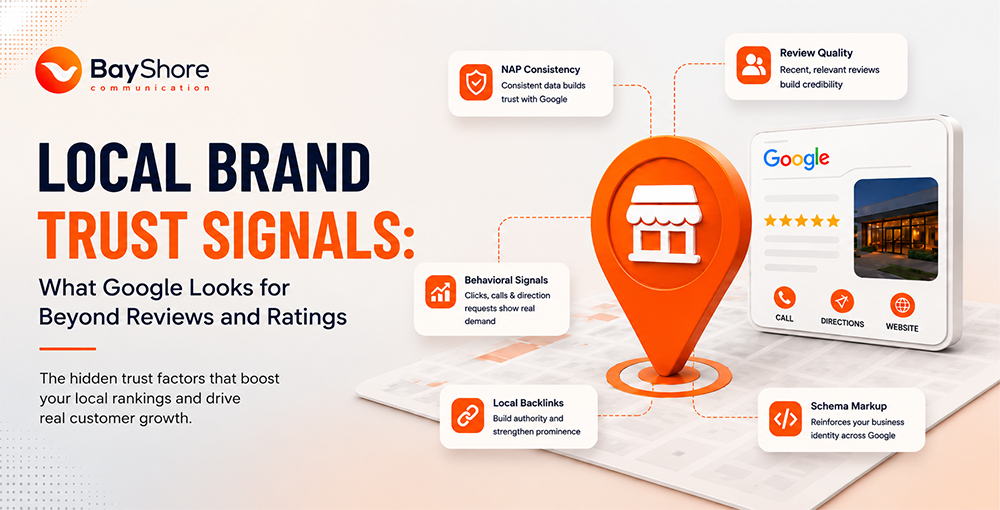
Key Trust Signals at a Glance
NAP Consistency
Consistent business name, address, and phone data helps Google verify your local identity across the web.
Behavioral Signals
Clicks, calls, website visits, and direction requests show that real searchers choose and engage with your business.
Schema Markup
LocalBusiness schema reinforces your business identity in a machine-readable format.
GBP Engagement
An active Google Business Profile signals live, customer-driven credibility.
Local Backlinks
Links and mentions from local publishers, partners, and community sites build prominence.
Review Quality
Fresh, specific, keyword-rich reviews strengthen relevance more than star count alone.
40%
More likely to appear in the Local Pack with consistent NAP data
28%
Higher conversions reported for 4.2-4.7 ratings than perfect 5.0 scores
73%
Consumers in the PDF data focused on reviews from the past 30 days
62%
Consumers who would avoid a business with incorrect online information
Why Star Ratings Are Not the Whole Story
Reviews matter, but they are not the whole local SEO system. Google's local algorithm reads a wider credibility pattern before deciding which businesses deserve visibility in Maps and the Local Pack.
The PDF research highlights an important point: businesses rated between 4.2 and 4.7 can convert better than businesses with perfect 5.0 scores. Customers often trust a realistic review profile more than perfection. Google also reads review velocity, recency, and the language inside review text.
A review that mentions a specific service and city, such as "fast plumber in Phoenix," gives Google more relevance context than a generic "great service" review. The language inside reviews feeds Google's understanding of what you do, where you serve people, and which searches your business should appear for.
Reviews now drive a meaningful share of local pack ranking influence according to BrightLocal's local ranking overview, but the larger opportunity is the rest of the trust scorecard. In practical terms, that means review campaigns work best after your NAP data, Google Business Profile, local mentions, schema, and on-site experience are already aligned.
What NAP Consistency Tells Google About Your Business
NAP stands for name, address, and phone number. It is the business identity signal scattered across Google, Yelp, Apple Maps, Facebook, industry directories, and local citation sites.
When your NAP appears identically across those sources, Google gains confidence in who you are. When the name is abbreviated in one place, the phone number is old in another, and the address format is inconsistent elsewhere, the algorithm has to resolve conflict before it can trust the entity.
Local SEO is built on trust. If Google cannot match your identity across the web, nothing else reaches full strength.
Think of NAP as connective tissue for your digital footprint. Clean, consistent identity data tells Google your business is stable, real, and trustworthy. A fractured identity creates ranking doubt that no review campaign can fully repair.
The business impact is not only algorithmic. Incorrect listings can send customers to the wrong location, show old phone numbers, or create hesitation before a call. That means NAP issues can cost both rankings and leads.
Does Your Google Business Profile Signal Trust Beyond Reviews?
Yes. Your Google Business Profile is Google's direct window into local credibility. Claiming it once is not enough. Google looks at how complete, accurate, and active the profile remains over time.
Strong profiles use accurate primary and secondary categories, real team and location photos, updated hours, active Q&A management, and thoughtful review responses. Google's own local ranking guidance says local results are based on relevance, distance, and prominence, and it encourages complete, accurate business information.
User engagement inside your profile also matters. Direction requests, calls, website clicks, photo views, and profile interactions indicate real demand. A stale or incomplete profile can hurt visibility and misrepresent the business in AI-assisted local results.
Google's AI-powered local surfaces can pull business details from live profiles. That makes completeness and accuracy more important than a one-time setup. A profile should reflect current services, current hours, current photos, and current customer questions.
For a stronger local SEO system, pair GBP improvements with Bayshore Communication's growth plan.
Ready to Build Trust Beyond Reviews?
Bayshore Communication helps local businesses strengthen the trust signals Google reads across profiles, pages, citations, content, backlinks, and customer behavior.
Talk to Bayshore CommunicationCan Local Backlinks and Brand Mentions Change Rankings?
Yes. Google's prominence factor is shaped by how well-known a business appears to be across the wider web. Local backlinks from news sites, chambers of commerce, community blogs, suppliers, and partner businesses all strengthen authority.
Even unlinked brand mentions can help build entity associations. When a trusted local publisher writes about your business, Google can connect your brand name with a place, category, and context.Moz's local ranking factor research has consistently treated link signals as an important part of the local ranking picture.
Earning local backlinks does not require a huge PR budget. Sponsor community events, join relevant associations, land features in local roundups, and build partnerships with complementary businesses. One credible local write-up often beats dozens of generic directory listings.
How Behavioral Signals Prove Local Credibility
Google does not only evaluate what businesses say about themselves. It also reads what searchers do when they see a listing. Clicks from the Local Pack, direction requests, phone calls, website visits, and on-site engagement after a Google click all contribute to a demand pattern.
This is the most underrated local SEO trust category because it is based on actual customer choices. When searchers repeatedly choose one listing, call from it, request directions, and stay engaged after clicking through, that behavior sends a stronger credibility signal than self-reported marketing claims.
This is why photos, descriptions, services, and landing page quality matter. They improve conversion behavior, and that behavior can reinforce local trust. A business earning consistent clicks and calls may outperform a competitor with a slightly higher rating but weaker engagement.
Search Engine Journal's local ranking guide also emphasizes that local performance depends on a broad set of profile, relevance, prominence, and engagement signals rather than reviews alone.
What Schema Markup Does for Local Trust
Schema markup is structured code that tells search engines what your business is, where it operates, how customers can contact it, and which services it provides. For local businesses, LocalBusiness schema turns important business details into machine-readable data.
Google's LocalBusiness structured data documentation explains that structured data can communicate hours, departments, reviews, and other business details. When schema matches your GBP and website content, it reinforces the same identity across multiple sources.
Without schema, Google has to infer more. With schema, you clarify the business entity directly. Pair it with consistent service pages and content development to cover more of your local trust footprint.
Weak Local Trust Foundation
- Business name, phone, or address changes across listings
- Google Business Profile claimed once, then left stale
- Generic reviews with little service or location context
- No local backlinks or credible community mentions
- Missing LocalBusiness schema on the website
Strong Local Trust Foundation
- Name, address, and phone number match across major platforms
- GBP has fresh photos, posts, Q&A, services, and responses
- Reviews mention real services, cities, problems, and outcomes
- Local publishers, partners, and organizations mention the brand
- Schema, GBP, and on-page content reinforce the same identity
Full Trust Signal Scorecard
Bayshore Survey Finding
What 50+ Local Business Campaigns Revealed
After analyzing performance data from more than 50 local business campaigns managed by Bayshore Communication's growth marketing team, we found a clear pattern: businesses that fixed NAP inconsistencies and added LocalBusiness schema before launching a review campaign saw stronger Local Pack visibility.
Clients that handled these foundational signals first saw an average 34% improvement in Local Pack visibility within 90 days. Businesses that pushed review campaigns without fixing the base saw minimal ranking movement, even with more review volume.
"We always audit NAP consistency, GBP completeness, and behavioral engagement before we touch review strategy. You cannot build on a cracked foundation. First, fix the base, then turn it up."
Salman H Saikote, CTO, Bayshore Communication
Review campaigns work best when they are built on a solid local trust foundation. You can see more practical examples in the Bayshore Communication case studies.
Need a Local SEO Trust Audit?
Bayshore Communication can review your listings, Google Business Profile, schema, content, backlinks, and conversion behavior to show where Google may be losing confidence in your local brand.
Request a Local Trust AuditFrequently Asked Questions
Local Brand Trust Signals FAQ
Does Google rank local businesses only by reviews and proximity?
No. Google uses relevance, distance, and prominence. Prominence includes backlinks, brand mentions, Google Business Profile engagement, behavioral signals, and reviews.
How often should I update my Google Business Profile?
Update it at least once a week with fresh photos, posts, Q&A management, service changes, and review responses. A stale profile sends weaker credibility signals.
What is the fastest local trust signal to fix?
NAP consistency. Audit your business name, address, and phone number across Google, Yelp, Facebook, Apple Maps, and key directories, then correct every mismatch.
Do unlinked brand mentions help local SEO?
Yes. Brand mentions can help Google associate your business with a place, category, and topic, even when the mention does not include a hyperlink.
Can a lower-rated business outrank a higher-rated competitor?
Absolutely. Review velocity, profile engagement, behavioral signals, local backlinks, and structured data alignment can outweigh a small star-rating advantage.
Final Thoughts
Google checks more than reviews when ranking local brands. The strongest local SEO strategy connects accurate NAP data, an active Google Business Profile, local backlinks, customer behavior, schema markup, and useful review content into one trust system. Build that foundation first, then every review you earn has more power.
Ready to build a local trust strategy that goes beyond chasing reviews? Explore the Bayshore Communication Growth Plan or contact our team today.