Bayshore Communication | Organic SEO Services
Organic SEO is really just the honest and hard work you put in to earn your spot on Google. You aren't renting a billboard or paying for an ad that disappears tomorrow.
Organic SEO is really just the honest and hard work you put in to earn your spot on Google. You aren't renting a billboard or paying for an ad that disappears tomorrow. You'd rather build upon your domain through quality content creation, technical optimization, and backlinks. Keyword research and optimization, technical SEO, content marketing, local citations, and backlink building are all elements of organic SEO. Most importantly, your investment isn't gone after you finish paying for the campaign as it is with other forms of SEO.
KEY POINTS
• Organic SEO isn’t about the paid ads on top but the unpaid ones right underneath.
• Organic SEO is a confluence of four practices, including technical, on-page, off-page and local SEO.
• Results build over months, then compound for years without new spend.
• Local intent now drives nearly half of all Google searches.
• Florida businesses compete in some of the country's most saturated local markets.
Organic search still generates 53% of all website traffic, more than paid search, social, and direct visits combined, according to BrightEdge's 2026 enterprise search research. That's not a leftover statistic from the pre-AI internet. If over half your potential folks are coming through the front door of unpaid search and you are just standing on the porch doing nothing, well, you are giving away the biggest street corner on the internet to whoever took the time to set up shop.
What Exactly Fits Within "Organic SEO Services"?
SEO isn't just one single chore. It's 4 different jobs working in harmony. Truth is, a lot of agencies quietly skip one or two of them.
1. Technical SEO
Technical SEO is all about making sure Google can actually read your place without tripping over its own feet. We are talking page speed, how it looks on a phone, structured data and how the whole place is built. If the search engines can't crawl your site cleanly, nothing else you do matters one bit.
2. On-page SEO
On-page SEO handles the actual words on the screen. The page titles, the headers, the main stories, natural links and placing keywords so they feel like a friendly conversation instead of a stuffed holiday turkey. Most business folks think this is where SEO starts and ends. Truth is, it's step two, not step one.
3. Off-page SEO
Off-page SEO is reputation building outside your own site. Backlinks from relevant, high authority domains, digital PR and guest posting opportunities. Google officially states that votes from other sites are taken into consideration when ranking pages. The Google Search Central documentation is explicit that link quality outweighs link volume.
4. Local SEO
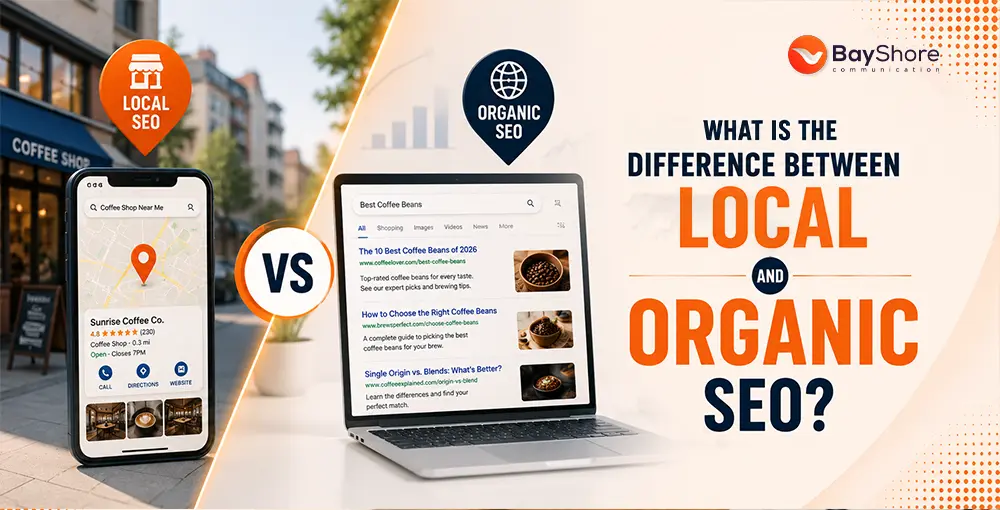
Local SEO is the last pillar and probably the quickest way to get results for someone based in Tampa, Orlando, or any other city in Florida. It includes optimizing the Google Business listing and citations.
THE 4 PILLARS BY THE NUMBERS
53%
of web traffic is organic
46%
of searches carry local intent
27.6%
CTR for the #1 result
96.55%
of pages get zero traffic
Bayshore Communication develops an organic strategy focusing on all four areas since the neglect of any one of them leads to mediocre results that are simply not worth the investment. Having a site full of relevant content but with technical issues won't get it ranked on the first page. A technically sound website with no local optimization will fail to attract the customers in the area to it, while a similar site with some reviews and being claimed on Google will have an advantage over it.
Organic SEO Takes Longer Than Paid Ads, But Why ?
Because it's not renting attention but earning authority. After your budget is gone, the ads are gone. Organic traffic, when gained, lasts for years after the initial cost.
That compounding curve is the entire argument for organic SEO as a long-term asset instead of a monthly expense. A well-optimized blog post published today can still be generating leads in 2029. An ad campaign stops the day you stop paying for it.
Every $1 invested in SEO returns an average of $7.48 over three years, and that ratio actually improves after year two as the compounding effect kicks in, per Search Engine Journal's ROI analysis. Conversely, the ROI of the paid search channels resets for every spend cycle.
CLICK THROUGH RATE BY SEARCH POSITION
Source: Organic click-through rates by rank position based on industry search data.
The number one organic result now earns a 27.6% average click-through rate, and the top three results combined take over half of all clicks on the page, according to Backlinko's 2025 click-through study. Rank on page two, and functionally, you don't exist. This is exactly why Bayshore Communication's SEO team treats keyword difficulty and current ranking position as the starting line for every client engagement, not an afterthought tacked onto month three.
Does Local SEO Actually Matter for a Florida Business?
Enormously, and the data on this is getting harder to ignore. 46% of all Google searches have local intent. Meaning, someone isn't simply browsing but actually searching for a personal injury lawyer near them (and probably considering hiring one soon) when they type "personal injury lawyer near me" into Google in Tampa, for example.
Mobile "near me" searches have grown 900% over the past two years, and 76% of people who run a local mobile search visit a business within 24 hours, according to Google's local search behavior data. That's not top-of-funnel awareness. That's a buyer standing at the decision point, phone in hand, choosing between whoever shows up first and whoever doesn't show up at all.
900%
growth in "near me" searches
76%
visit within 24 hours
28%
of local searches convert
Florida makes this sharper than most states. You've got dense metro competition in Tampa, Orlando, and Miami, plus a huge volume of service businesses fighting over the same "near me" searches. A law firm in South Tampa isn't just competing citywide. It's competing block by block against three other firms running the exact same Google Business Profile play.
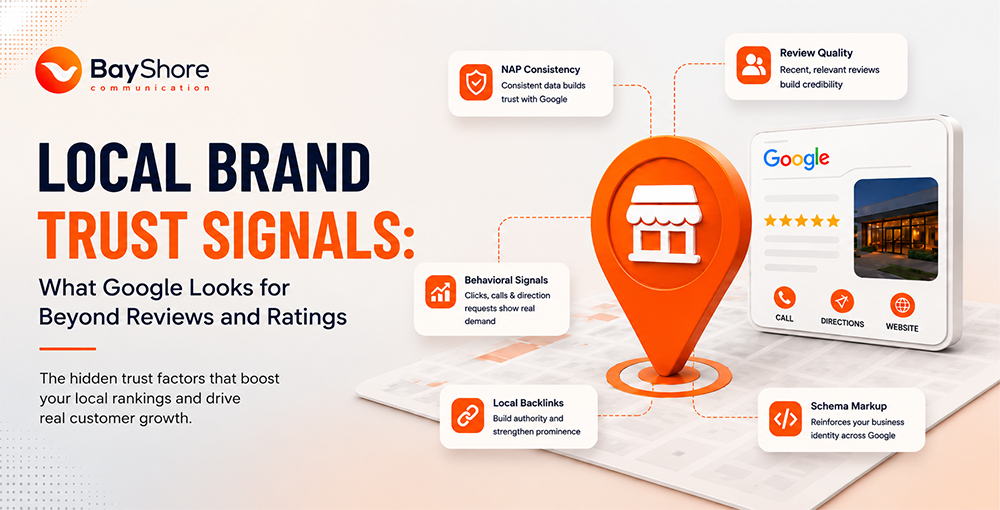
“Achieving top rankings relies on building search engine trust regarding physical location, operational legitimacy, subject relevance, rather than site decoration. Consistency establishes that credibility, whereas visual flash fails to convince algorithms.”
— Salman H Saikote, Managing Partner, Bayshore Communication
Bayshore Communication's local SEO services lean hard into this reality for Florida clients, because a generic national SEO play misses the block-by-block competition that decides who actually gets the call.
What Does Bayshore Communication's Data Actually Show?
Here's where a lot of SEO advice stops being useful and starts being generic. So let's get specific about what shows up across real client accounts instead of textbook theory.
Across the client campaigns Bayshore Communication has run for Florida law firms, medical practices, and service businesses, the pattern is consistent. Clients who commit to organic SEO for at least six consecutive months see ranking movement that clients running three-month "test" campaigns almost never see. SEO isn't slow because agencies are lazy, SEO is slow because Google wants to see multiple recurring signals before granting trust to a domain.
WHAT CHANGES OVER A TYPICAL ENGAGEMENT
BEFORE
- ✕Ranking page 3+ for core service terms
- ✕Google Business Profile incomplete, few reviews
- ✕Organic traffic flat or declining month over month
- ✕No local pack visibility in target cities
AFTER
- ✓Top 3 ranking for primary commercial keywords
- ✓Optimized profile with consistent review flow
- ✓Steady month-over-month organic growth
- ✓Regular local pack placement in service areas
The businesses that struggle most aren't the ones in tough industries. They're the ones treating SEO like a light switch, on for a quarter, off when a quarterly report doesn't show explosive growth, then on again eight months later after rankings have decayed back to where they started.
Organic SEO is Still Worth It Even With AI Overviews Everywhere
Organic SEO is becoming less sustainable due to Google's zero-click searches, however it is still valuable because of increased traffic to websites through the rich snippets and featured content. It appears that AI Overviews have increased the number of zero-click searches tremendously, where Google is providing answers to questions directly in the search results rather than following through with clicking on a link to a site.
That sounds like bad news for organic SEO. It isn't, not entirely. Being the source an AI Overview cites requires the exact same foundation organic SEO has always required, structured, authoritative content that directly answers a question. Sites with strong existing organic authority are the ones getting pulled into AI-generated answers and local recommendation panels. Sites with thin, unoptimized content are invisible in both the old rankings and the new AI layer.
Not Sure Where Your Site Stands?
Bayshore Communication offers a free consultation to map out exactly where your organic visibility stands today.
According to BrightEdge's 2026 research on enterprise search performance, organic and paid search combined still account for 68% of all trackable website traffic, underscoring that unpaid search remains the dominant discovery channel even as the results page itself keeps changing shape. The format of the answer is evolving. The requirement to actually earn authority underneath it hasn't gone anywhere.
How Do You Know an Organic SEO Strategy Is Actually Working?
Rankings alone are a vanity metric if nobody's converting. The true metrics to focus on are increases in organic traffic, improvements in rankings for commercial keywords, conversion rates from organic search, and visibility in local packs for your key service areas.
ORGANIC MOMENTUM BUILDING
Month 1-2
Setup
Technical fixes, audit & keyword mapping
Month 3-4
Early signals
Indexation & initial query impressions
Month 5-6
Ranking movement
Page 1-2 entries for target keywords
Month 9-12
Compounding
Consistent top rankings & lead conversion
Year 2+
Momentum
Dominant authority & reduced acquisition cost
A site can gain traffic while losing business if the traffic is the wrong traffic. This is why Bayshore Communication weights keyword selection toward commercial and local intent from day one, instead of chasing broad informational terms that bring visitors who were never going to become customers anyway. Volume without intent is a hollow number on a report.
96.55% of all published web pages receive zero organic traffic from Google, according to Ahrefs' most recent crawl data. That statistic should stop any Florida business owner cold. The vast majority of the content that’s published online is invisible to the majority of the people who are interacting with the websites. It isn't because they’re intentionally buried by Google but they haven't received the signals indicating that they're worth being seen or found.
“The sites that are winning in 2026 are not publishing more content but rather have content that wins in terms of citations, whether it be in first page results or through the AI Overview.”
— Industry Analysis, BrightEdge 2026 Enterprise Search Report
For a Florida business trying to decide whether to build organic authority in-house or bring in a partner, the case studies on Bayshore Communication's site walk through exactly how that ranking movement plays out across different industries, from immigration law to hospitality.
Ready to Turn Organic Search Into Your Biggest Lead Channel?
Bayshore Communication builds and manages full-funnel organic SEO strategy for Florida businesses, from technical audits to local pack domination.
Frequently Asked Questions
FAQ About Organic SEO Services
Q What is the difference between a technical site audit and ongoing SEO work?
An audit is an inspection that points out everything broken on your site. SEO work is actually working to fix the problems and writing new content and gaining trust.
Q How much content should I be publishing each month?
It’s better to have 3-4 quality articles that answer your customers' questions than it is to have twenty generic articles that no one wants to read.
Q Do I need to rewrite my entire website to see ranking improvements?
Almost never. Most of the time you refine what is already sitting there. Refining existing content, improving page titles, adding direct answers to buyer questions produce solid progress.
Q What if my website is old or built on an older platform?
An older site can actually work in your favor because Google recognizes domain age and history. Although you might need some technical fixes under the hood to improve speed and mobile performance.